
Quick summary
Four things have real evidence behind them: strength and balance exercise, a medication review, an eyesight test, and fixing the hazards in the house. Exercise is the strongest, reducing the rate of falls by around 23 per cent. Almost everything else is secondary, and fall alarms are not prevention at all.
Why this matters
Around a third of people aged 65 and over, and around half of people aged 80 and over, fall at least once a year. Government guidance is clear that falls and fractures in older people are often preventable (Office for Health Improvement and Disparities, 2022).
“Often preventable” is the part worth sitting with. Falls are not an inevitable feature of getting older, and the four things below are where the evidence actually is.
1. Strength and balance exercise
The single most effective thing, and the one people do least.
A Cochrane review of 108 randomised trials involving 23,407 people found that exercise reduces the rate of falls by around 23 per cent and the number of people who fall at all by around 15 per cent. The average participant was 76 (Cochrane, 2019).
The detail matters. Balance and functional training drove the effect. Walking on its own did not. Programmes combining balance work with resistance exercise probably reduced falls further.
NICE says a falls prevention exercise programme should be progressive, tailored to the person, focused on balance, coordination, strength and power, and reviewed as it goes (NICE NG249, April 2025). The NHS recommends older adults do some activity every day, build to 150 minutes of moderate activity a week, and include strength, balance and flexibility work at least twice a week (NHS).
Free locally: Stand Strong, a 26-week strength and balance programme run by One You Cheshire East on 0300 123 5026, for residents aged 65 and over who have had two or more falls, have fallen in the past year, or have difficulty walking or with balance. For Buxton and Whaley Bridge, Live Stronger for Longer through Age UK Derby and Derbyshire on 01773 766922. For Leek, Biddulph and Kidsgrove, Steady On Your Feet Staffordshire and Stoke-on-Trent.
2. A medication review
The quickest win on the list, and it takes one appointment.
Taking four or more medicines is associated with an 18 per cent increase in fall rates in people over 60, and medicines acting on the brain, including sleeping tablets, anxiety medicines and antidepressants, add further risk (Izza and colleagues, European Geriatric Medicine, 2020). NICE lists polypharmacy and psychotropic and antiarrhythmic medicines among the factors that raise falls risk, and recommends a medication review as part of falls management.
It does not happen automatically. A study presented to the British Geriatrics Society found that three months after a hospital discharge following a fall, older people were on more falls-related medicines than on admission, not fewer.
Take every box, including anything bought over the counter, to the GP or pharmacist and ask which could be contributing. Nobody should stop a medicine on the basis of an article.
3. Eyesight
Vision problems including cataracts sit on NICE’s list of modifiable risk factors, and cataract surgery is named in the guidance as an intervention that can change someone’s risk.
Two specific traps. New varifocals blur the ground through the lower part of the lens, exactly where you need sharpness on a staircase, and it takes time to adapt. And contrast matters more than sharpness: a cream stair carpet against a cream wall is a hazard for someone who passed their eye test.
NHS sight tests are free for anyone aged 60 and over.
4. The house
Worth doing, and worth doing properly rather than as a tidy-up.
NICE recommends a home hazard assessment using a validated tool, ideally carried out by an occupational therapist. That is an assessment of how someone actually moves around their own home, not a walk round pulling up rugs.
The common ones: loose rugs and trailing wires, poor lighting on stairs and landings, no second stair rail, a bath being used when a shower would be safer, things stored too high or too low, and slippers without backs. RoSPA reports that falls on stairs and steps kill more than 1,000 people a year in England and Wales, with around 43,000 more admitted to hospital.
Occupational therapy is arranged through adult social care: Cheshire East Council on 0300 123 5010, Call Derbyshire on 01629 533190, Staffordshire Cares on 0300 111 8010. Grants for bigger adaptations come from the district or borough council, which in the border towns is a different organisation, as our guide to which council to ring explains.
The things that matter but sit underneath
- Blood pressure dropping on standing. Common, easily missed, and found with a lying and standing blood pressure check. Worth asking for by name.
- Eating and drinking enough. The NHS names this, because not eating and drinking enough can cause lightheadedness. See the signs someone is not managing at home.
- Feet and footwear. Painful feet change how people walk. A podiatry appointment and proper slippers are unglamorous and effective.
- Hearing. Balance depends partly on the inner ear, and hearing loss sits on the NHS list of causes.
- Bone strength. This does not prevent falls, it prevents fractures. After a fragility fracture, ask about osteoporosis treatment.
- Alcohol, which appears on NHS falls prevention advice and interacts with sedating medicines.
What does not prevent falls
- Fall alarms. They shorten the time on the floor afterwards, which matters a great deal and is a different thing. We compare the options separately.
- Falls risk scores. NICE now recommends against using falls risk prediction tools to predict whether someone will fall.
- Telling someone to be careful. It has no effect except making people anxious, and anxiety makes walking worse.
- Doing everything for them. Less activity means weaker legs, which raises risk rather than lowering it.
- Most supplements, unless a clinician has identified a specific deficiency.
Where to start
- Ring the GP and use the word “fall”. Ask for a falls assessment, a medication review and a lying and standing blood pressure check. NICE says anyone 65 and over who has fallen should have their gait and balance assessed, with a fuller assessment for anyone injured, who blacked out, is living with frailty, or could not get up alone.
- Book the free eye test.
- Ring Stand Strong, or the equivalent for your area. It costs nothing.
- Ask adult social care for an occupational therapy assessment.
- Then, and only then, think about alarms and technology.
Frequently asked questions
What is the best way to prevent falls in the elderly?
Progressive strength and balance exercise has the strongest evidence, reducing the rate of falls by around 23 per cent. It works best alongside a medication review, an eye test and a proper home hazard assessment.
How much exercise is needed?
The NHS recommends strength and balance work at least twice a week, alongside daily activity. Local programmes such as Stand Strong run for 26 weeks, which gives a sense of the realistic timescale.
Is it too late to start at 85?
The Cochrane trials had an average participant age of 76 and included people already at increased risk. Ask a GP or physiotherapist what is appropriate rather than ruling it out on age.
Do hip protectors work?
They aim to reduce fracture risk rather than prevent falls, and the evidence is mixed and depends heavily on whether people actually wear them. Discuss with a clinician rather than buying on spec.
Does a walking frame help or make things worse?
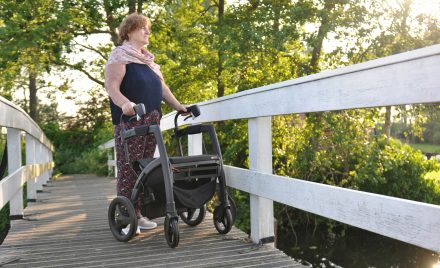
The right aid, correctly measured and correctly used, helps. The wrong one, or one that was borrowed or inherited, can make things worse. Get it fitted by a physiotherapist or occupational therapist.
Can a carer prevent falls?
Not directly. A carer can prompt the exercises a physiotherapist set, be there at the time of day falls keep happening, and notice the changes that precede one. The prevention itself comes from the four things above.
About Visiting Angels Cheshire East
Visiting Angels Cheshire East provides care at home across Macclesfield, Wilmslow, Knutsford, Congleton, Alsager and the surrounding villages of East Cheshire, along with Buxton, Whaley Bridge and the Staffordshire Moorlands towns.
- No visit is ever shorter than an hour, so there is time to prompt exercises and get someone out walking rather than only completing tasks.
- You see the same faces. Our carer turnover is 12 per cent, against a sector figure of 23.7 per cent (Skills for Care, 2025), and the same carer notices when someone is less steady than last week.
- You choose your caregiver, and meet them before care starts.
- Carers trained in dementia, Parkinson’s, stroke recovery and complex care.
- Live-in care available, up to full time.
Iain wrote this about the help his mother receives:
“Visiting Angels have been a great help to my mother with cleaning, shopping, taking her for walks and by simply keeping her company.”
Iain Brook, Google review
Not sure what you need yet? Start with a free assessment
Our free home care assessment is a visit at a time that suits you, with no obligation afterwards. In it we will:
- Work out when and where the near misses are happening, which is usually more revealing than the falls themselves.
- Talk through a realistic package, and what it would cost.
- Look at the money with you, and point you towards the funding, benefits and grants you may be entitled to.
- Point you at the free programmes first, because the GP appointment and Stand Strong will do more for falls than we will.
If someone has started to become unsteady, call us on 01625 720157. You can also send an enquiry, and you can see what our services cover.
Authored by Dr Niall Jawad, Managing Director, Visiting Angels Cheshire East.
Published 27 September 2026. Last updated 27 September 2026.
This article is general information, not medical advice, and no substitute for a GP, physiotherapist or other professional who knows the person. Do not start a new exercise programme, or start, stop or change any medicine, without appropriate advice. The author is a director of the company and is not acting in a clinical capacity, and Visiting Angels Cheshire East provides personal care at home rather than medical or nursing care. If someone has fallen and is injured, call 999. To the fullest extent permitted by law, GB Care at Home Ltd accepts no liability for any loss or injury arising from reliance on this article.