
What is a long lie, and why does an hour on the floor matter?
Quick summary
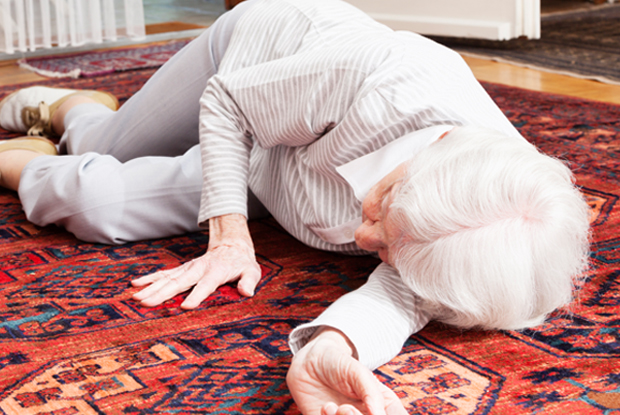
A long lie means being on the floor for an hour or more after a fall. It causes harm on its own, separately from the fall: dehydration, pressure damage, muscle breakdown that can injure the kidneys, and hypothermia. In research on people over 90, four in five could not get up unaided and 30 per cent had lain there an hour or more.
What counts as a long lie?
An hour is the threshold used in the literature. It is a working line rather than a moment when something specific happens, but it has held up well enough that clinicians and ambulance services use it.
The term matters because it separates two different problems. The fall may have caused no injury at all. The time afterwards is what does the damage, and it is measured from the moment they went down.
How often does it happen?
Far more often than families assume, and the best UK evidence is uncomfortable reading.
A Cambridge study followed people aged over 90 for a year and recorded 265 falls. Eighty two per cent happened when the person was alone. Of those who fell, four in five could not get up after at least one fall, and 30 per cent had lain on the floor for an hour or more. Long periods on the floor were strongly associated with serious injury, hospital admission and later moves into long term care (Fleming and Brayne, BMJ, 2008).
The same study found that cognition was the characteristic that predicted a long lie. Not age, not frailty, not the severity of the fall. Whether the person could work out what to do next.
What does an hour on the floor actually do?
What happens | Why it matters |
|---|---|
Dehydration | No fluids for hours, often after several hours without a drink beforehand. Older people dehydrate faster and it worsens confusion and blood pressure |
Pressure damage | Skin over the hip, heel, elbow and shoulder breaks down under sustained pressure. A pressure ulcer that starts on a kitchen floor can take months to heal |
Muscle breakdown | Sustained compression damages muscle, releasing proteins that can injure the kidneys. This is rhabdomyolysis, and it is a recognised complication of prolonged immobility after a fall |
Hypothermia | A tiled or flagged floor pulls heat out of a still body quickly. Cold stone floors in older cottages around Wincle, Longnor and Meerbrook make this a genuine winter risk |
Loss of confidence | The lasting one. People who have lain on a floor for hours often stop doing the things that keep them strong, which makes the next fall more likely |
Why do people not just call for help?
This is the part that surprises families most.
The Cambridge research looked at call alarms and found that people who had one frequently did not use it to summon help, even while on the floor and unable to get up.
The reasons are ordinary. The pendant is on the bedside table because it catches on clothing. The phone is charging in the hall. It is three in the morning and they do not want to wake anyone. They are convinced they will manage in a minute, and then it is four hours later. And in some cases, after a knock to the head or with existing cognitive impairment, the plan simply does not form.
What should someone do if they cannot get up?
The NHS advice is to stop trying to stand, and change the goal to being found quickly and staying warm.
- Use a phone or personal alarm if one is within reach.
- If not, shout, or bang on a wall or the floor.
- Pull a coat, rug, towel or cushion over yourself to keep warm.
- Keep moving arms and legs.
- Change position roughly every 30 minutes to protect the skin.
Moving away from a cold hard floor onto carpet, even by shuffling a couple of feet, is worth the effort if it can be done without pain.
What should I tell the ambulance service?
Say how long they were down for, and say it early in the call.
It changes the clinical picture. Someone found after four hours needs assessing for dehydration, kidney function, pressure damage and body temperature, not only for the injuries from the fall itself. A crew told “she fell” will treat a different problem from a crew told “she fell and was on the floor most of the night”.
If you do not know how long, say what you do know: when they were last seen or last spoke to someone, and when they were found. That brackets it usefully.
How do you stop a long lie happening?
Not with one thing. With a chain, where each link is unremarkable on its own.
- An alarm that is actually worn. Pressing it is a habit that needs discussing before it is needed, not during.
- A phone in a pocket, not on charge in another room. A cordless handset in the room they spend most time in is the low technology version.
- Practising getting up from the floor, with a physiotherapist. It is a trainable skill and almost nobody trains it.
- A daily check in at a set time, so an unanswered call means something.
- A key safe, so nobody has to break a door down and no crew loses time outside.
- Warm floors where the falls happen, meaning bathroom and kitchen, since those are the cold hard surfaces.
The blunt point is that most of this is about being found, not about not falling. Prevention and detection are separate problems and they need separate answers.
Why professionals use the term
If you are reading this as a district nurse, discharge coordinator or paramedic rather than as a family member, the phrase does specific work in a handover.
“Long lie” flags a package of risks in two words, and it changes both the immediate assessment and the discharge plan, because someone who has had one is by definition someone whose current arrangements did not detect a fall. That is a different conversation from injury management, and it is usually where a care package, a technology referral or a change in living arrangements gets raised.
Frequently asked questions
Is an hour the real cutoff?
It is the threshold used in research rather than a switch that flips. Harm accumulates gradually, and the practical instruction is to get help as fast as possible rather than to watch a clock.
They were on the floor a long time but seem fine. Do they still need checking?
Yes. Dehydration, kidney injury and pressure damage do not announce themselves at the time. Ring 111 as a minimum and say how long they were down.
Do fall detector alarms work?
Automatic detectors remove the need to press a button, which addresses the biggest single failure point. They are not perfect, they miss some falls and trigger on some non-falls, but for someone with cognitive impairment they solve a problem a manual pendant does not.
Would a camera solve it?
It can, and it raises questions worth taking seriously about privacy and consent in someone’s own home. If the person cannot meaningfully agree to it, that is a decision that needs proper thought rather than an app.
Does a carer visit prevent a long lie?
It shortens the worst case. A daily visit means the maximum time on a floor is measured against the gap between visits rather than against how long until someone happens to phone. Two visits a day halves that window again.
About Visiting Angels Cheshire East
Visiting Angels Cheshire East provides care at home across Macclesfield, Wilmslow, Knutsford, Congleton and the surrounding villages, along with Buxton, Whaley Bridge, Chapel-en-le-Frith and the Staffordshire Moorlands towns.
- You choose your caregiver. You meet them before care starts, and if it is not right you say so and we send someone else.
- No visit is ever shorter than an hour. There is no such thing as a fifteen minute call here.
- You see the same faces. Our carer turnover is 12 per cent, against a sector figure of 23.7 per cent (Skills for Care, 2025).
- Carers trained in dementia, Parkinson’s, stroke recovery and complex care.
- Live-in care available, up to full time, where someone should not be alone overnight.
David’s mother in law is becoming increasingly confused, and being there at the times the family cannot be is the whole point:
“Visiting angels have been a massive help in the care for my mother in law, who is getting increasingly confused. They provide companionship and support every day proving to be very reliable and consistent. They are there at times we can’t be, due to all the commitments of work and grand children.”
David Figg, Google review
Not sure what you need yet? Start with a free assessment
Our free home care assessment is a visit at a time that suits you, with no obligation afterwards. In it we will:
- Work out what is actually difficult, and which times of day, which is usually what a visit should be built around.
- Talk through a realistic package, and what it would cost.
- Look at the money with you, and point you towards the funding, benefits and grants you may be entitled to, including the ones most families are never told about.
- Tell you honestly if you do not need us yet, or if someone else is a better fit.
If someone is spending long stretches alone and you are worried about how long it would take to find them, call us on 01625 720157. You can also WhatsApp us or send an enquiry, or check the areas we cover.
Authored by Dr Haroon Ahmad, Managing Director, Visiting Angels Cheshire East.
Published 6 September 2026. Last updated 6 September 2026.
This article is general information, not medical advice, and no substitute for a professional who knows the person. The author is a director of the company and is not acting in a clinical capacity, and Visiting Angels Cheshire East provides personal care at home rather than medical or nursing care. Speak to a GP, a pharmacist or NHS 111 about your own situation, and call 999 in an emergency. Information correct at the date of publication. To the fullest extent permitted by law, GB Care at Home Ltd accepts no liability for any loss or injury arising from reliance on it.