
Quick summary
You do not need a gym or a class. You need a worktop to hold and ten minutes a day. Balance and strength work is the single most effective thing for preventing falls, reducing the rate of falls by around 23 per cent. Check with a GP or physiotherapist first, particularly if you have fallen recently.
Before you start: speak to a GP or physiotherapist if you have had a fall, have chest pain or dizziness, have had recent surgery, or are unsure whether these are right for you. Stop if anything hurts.
Why balance work specifically
Because it is the part with the evidence, and it is the part most people skip in favour of walking.
A Cochrane review of 108 trials involving 23,407 people found exercise reduces the rate of falls by around 23 per cent. Crucially, balance and functional training drove the effect, and walking on its own did not (Cochrane, 2019). Programmes combining balance work with resistance exercise probably did better still.
The NHS recommends adults over 65 include activities to improve strength, balance and flexibility at least twice a week, alongside daily activity (NHS physical activity guidelines for older adults). NICE adds that a falls prevention programme should be progressive, tailored and reviewed, which is why a class run by a physiotherapist beats anything on a web page, including this one.
Why the kitchen
A worktop is the right height, it does not move, and it runs in a line so you can side-step along it. Most people are in the kitchen several times a day anyway, which is what turns this into a habit rather than a plan.
Attach it to something you already do. While the kettle boils is the version most people stick with.
Six exercises
Stand close enough to the worktop to touch it at all times. Wear shoes or slippers with a back and a grip, not socks.
- Sit to stand. From a firm dining chair, stand up and sit down slowly, using your hands as little as you can manage. Aim for five to ten. This is the most useful exercise on the list, because getting out of a chair unaided is the thing that keeps people independent.
- Heel raises. Holding the worktop, rise onto your toes, hold for a second, lower slowly. Ten to fifteen. Builds the calf muscles used to correct a stumble.
- Toe raises. Same position, lift your toes and rock back onto your heels, then lower. Ten to fifteen.
- Sideways walking. Step sideways along the worktop, ten steps one way and ten back, keeping your body upright. Trains the hip muscles that stop you toppling sideways.
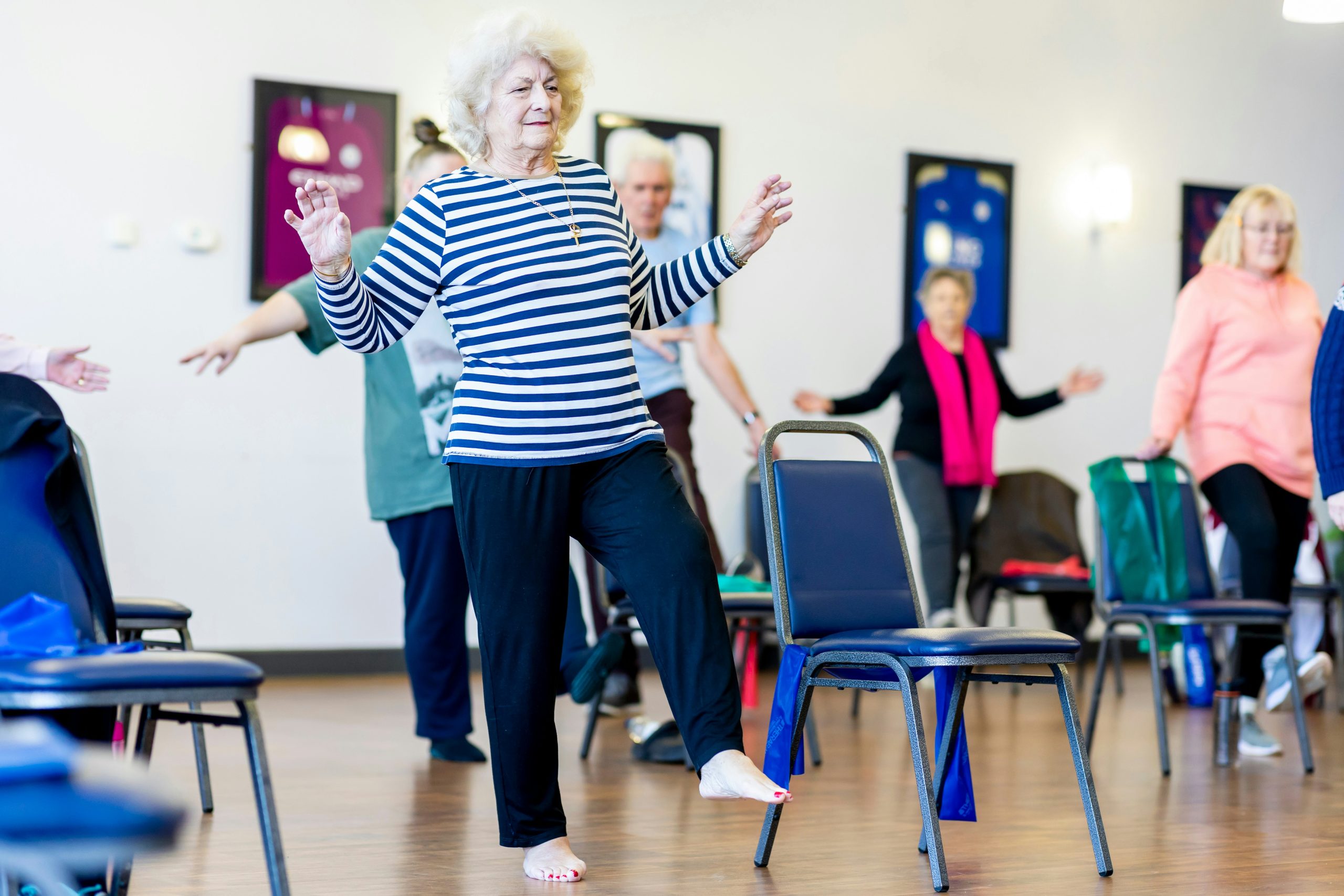
- One-leg stand. Holding on, lift one foot slightly off the floor and hold for up to ten seconds, then swap. Progress by holding with one hand, then fingertips.
- Heel-to-toe standing. Place one foot directly in front of the other, as if on a line, and hold for up to ten seconds. Swap feet. Progress to heel-to-toe walking along the worktop when it feels secure.
How to build it up
Stage | What it looks like | Roughly how long |
|---|---|---|
Starting out | Both hands on the worktop throughout. Small numbers of each | Weeks 1 to 2 |
Building | One hand on the worktop. More repetitions | Weeks 3 to 6 |
Progressing | Fingertips only, longer holds, heel-to-toe walking | Week 6 onwards |
Maintaining | Keep going, at least twice a week, indefinitely | Ongoing |
Progression is the whole point. NICE is explicit that these programmes should be progressive. Doing the same easy version for a year produces very little, because balance improves only when it is challenged.
It should feel slightly wobbly and never unsafe. If you could not catch yourself, you have gone a step too far.
Free classes, which are better than doing it alone
Home exercises work, and a proper programme works better, because someone watches how you move and adjusts it.
- Stand Strong, a free 26-week strength and balance programme from One You Cheshire East on 0300 123 5026, for residents aged 65 and over who have had two or more falls, have fallen in the past 12 months, or have difficulty with walking or balance.
- Live Stronger for Longer, Age UK Derby and Derbyshire on 01773 766922, for Buxton, Harpur Hill and Whaley Bridge. Their postural stability classes include getting back up from the floor.
- Steady On Your Feet Staffordshire and Stoke-on-Trent, for Leek, Biddulph and Kidsgrove.
If you are not sure which area you fall under, our guide to the council boundaries will tell you.
What else to do alongside
Exercise is one of four things with real evidence behind them. The others are a medication review, an eye test and a home hazard assessment, and skipping them limits what the exercises can achieve. Ask the GP for a falls assessment, a medication review and a lying and standing blood pressure check.
If dizziness on standing is part of the picture, that has its own cause and its own fix.
Frequently asked questions
What are the best balance exercises for older adults?
Sit to stand, heel raises, sideways walking, one-leg stands and heel-to-toe standing cover the main movements. What matters most is doing them at least twice a week and making them gradually harder.
How long before I notice a difference?
Often a few weeks for confidence and getting out of a chair. Local programmes run for 26 weeks, which gives a sense of the timescale for a real change in falls risk.
Is it safe to do these alone?
For many people, holding a worktop, yes. If you have fallen recently, feel dizzy, or are unsteady even when holding on, get advice first and have someone with you.
What if I can’t stand for long?
There are seated versions of most of these, and chair-based programmes exist locally. Ask about them rather than giving up on the idea.
Is walking enough?
Walking is good for you and did not reduce falls on its own in the Cochrane evidence. Balance and strength work is the part that does.
I’m 88. Is it too late?
The trials had an average participant age of 76 and included people already at increased risk of falling. Ask a GP or physiotherapist what is appropriate rather than ruling it out on age.
About Visiting Angels Cheshire East
Visiting Angels Cheshire East provides care at home across Macclesfield, Wilmslow, Knutsford, Congleton, Alsager and the surrounding villages of East Cheshire, along with Buxton, Whaley Bridge and the Staffordshire Moorlands towns.
- No visit is ever shorter than an hour, which is what makes it possible to prompt exercises and go for a walk rather than only completing tasks.
- You see the same faces. Our carer turnover is 12 per cent, against a sector figure of 23.7 per cent (Skills for Care, 2025), so the same carer sees whether someone is steadier this month than last.
- You choose your caregiver, and meet them before care starts.
- Carers trained in dementia, Parkinson’s, stroke recovery and complex care.
- Support to get to a class, including going in with someone the first few times.
Iain wrote this about the help his mother receives:
“Visiting Angels have been a great help to my mother with cleaning, shopping, taking her for walks and by simply keeping her company.”
Iain Brook, Google review
Not sure what you need yet? Start with a free assessment
Our free home care assessment is a visit at a time that suits you, with no obligation afterwards. In it we will:
- Work out what has become harder, including getting out of a chair and up the stairs.
- Talk through a realistic package, and what it would cost.
- Look at the money with you, and point you towards the funding, benefits and grants you may be entitled to.
- Point you at the free classes first, because a 26-week programme will do more for falls than we will.
If getting to a class is the obstacle rather than finding one, call us on 01625 720157. You can also send an enquiry, and you can see what our services cover.
Authored by Dr Niall Jawad, Managing Director, Visiting Angels Cheshire East.
Published 27 September 2026. Last updated 27 September 2026.
This article is general information, not medical advice, and no substitute for a GP or physiotherapist who knows the person. These exercises will not be suitable for everyone. Speak to a healthcare professional before starting, particularly after a fall, surgery, or if you experience dizziness, chest pain or breathlessness. Stop immediately if anything hurts, and always hold a stable surface. The author is a director of the company and is not acting in a clinical capacity, and Visiting Angels Cheshire East provides personal care at home rather than medical, nursing or physiotherapy services. To the fullest extent permitted by law, GB Care at Home Ltd accepts no liability for any loss or injury arising from reliance on this article.