
Quick summary
One fall is often enough to stop someone leaving the house, not because they cannot but because they are frightened to. Fear of falling is recognised, common and treatable. Doing less makes legs weaker, which makes another fall more likely, so the fear becomes partly justified. Breaking that loop is often the work.
This is a recognised condition, not a character flaw
It has been studied for decades and it has a literature of its own.
Reported prevalence varies from around 20 per cent to over 80 per cent depending on the population studied, and it is consistently higher in people who have already fallen (Scheffer and colleagues, Age and Ageing, 2008). It is associated with reduced activity, avoidance of things people used to do, low mood, less social contact and lower quality of life.
People often feel embarrassed about it, which is part of why it goes unmentioned at appointments. It is worth saying out loud precisely because there is something that can be done.
The loop
Understanding the mechanism makes the solution obvious.
- A fall happens. Frightening, possibly painful, possibly involving a long wait on the floor.
- Confidence drops. Reasonably. The world now contains a known risk.
- Activity drops. Fewer walks, fewer outings, more sitting.
- Muscles weaken and balance deteriorates. This happens faster in older adults than most people expect.
- The risk of falling genuinely rises.
- The fear is confirmed, and the loop tightens.
The fear turns out to be partly right, which is what makes it so hard to argue someone out of. You cannot reassure your way out of a loop that is producing real evidence. You can only interrupt it at step three or four.
What actually helps
- Strength and balance exercise, done properly. It works on two things at once: the legs get stronger, and doing something difficult and succeeding rebuilds confidence directly. Exercise reduces the rate of falls by around 23 per cent (Cochrane, 2019). Locally, Stand Strong in Cheshire East on 0300 123 5026 is free and runs for 26 weeks.
- Talking therapy, if exercise alone does not shift it. This is the part most people do not know exists. NICE recommends considering cognitive behavioural interventions for people whose concerns about falling are not helped by strength and balance exercises (NICE NG249, April 2025).
- Learning to get up off the floor. A large part of the fear is not the fall itself but lying there unable to move. Knowing you can get up changes that, and it is a trainable skill that physiotherapists teach.
- Dealing with the actual risk. Fear is easier to reduce when the risk has genuinely been reduced. A medication review, a lying and standing blood pressure check, an eye test and an occupational therapy assessment all make the reassurance honest. Our guide to what to look for at home covers some of the same ground.
- Graded return, not a leap. Small, achievable steps that build. The garden before the street, the street before the shop.
A realistic four-week plan
Week | Goal | Why |
|---|---|---|
1 | Walk to the end of the garden and back, daily, with someone there | Something achievable today. Success matters more than distance |
2 | To the gate and a short way along the pavement. Start the exercises from the falls service | Adds unfamiliar ground while support is still present |
3 | To the postbox or a neighbour’s, alone if that feels manageable | First time without a companion, on a known route |
4 | One outing that matters: the shop, the church, the group | A destination with people at the end, which is what makes it repeat |
If a week is too hard, repeat it rather than pushing on. If it is easy, hold the pace anyway. The aim is a run of successes, not a fast return.
What families get wrong
- “Be careful.” Said constantly, with the best intentions, and it reinforces the message that the world is dangerous.
- Taking over. Doing the shopping, the stairs and the garden for them removes the activity that would rebuild strength.
- Hovering. Walking half a step behind with hands out is unsettling and unbalancing. Walk beside them, normally.
- Pushing too fast. One bad experience can undo a month.
- Treating it as irrational. It is not. The risk is real, and the answer is to reduce it rather than deny it.
- Buying an alarm and calling it solved. Useful for what happens after, and it does nothing for confidence, and for some people it is a daily reminder of danger.
What to say instead
Instead of | Try |
|---|---|
“Be careful” | “Take your time, there’s no rush” |
“You shouldn’t be doing that” | “Shall we do it together?” |
“You’ll fall again” | “What would make that feel easier?” |
“Just sit down, I’ll do it” | “I’ll be here while you do it” |
“There’s nothing to worry about” | “That was frightening. What’s the bit you’re most worried about?” |
When it is more than fear of falling
Low mood, loss of interest in everything, poor sleep, weight loss, or someone saying life is not worth much point at depression rather than fear, and depression in later life is treatable. That is a GP appointment.
Someone who has stopped going out altogether is also at risk of becoming isolated, which carries its own health consequences. Our piece on the signs a parent is struggling covers what that looks like from the outside.
Frequently asked questions
Is being scared of falling normal after a fall?
Very. It is one of the most commonly reported consequences of falling, and it is treatable rather than something to put up with.
How long does it take to get confidence back?
It varies. Physical recovery from a fall often runs to weeks, and confidence frequently takes longer. Progress usually comes in small steps rather than one turning point.
Will a walking stick help or make it worse?
The right aid, measured and fitted by a physiotherapist, usually helps both stability and confidence. The wrong height, or one borrowed from a relative, can make things worse.
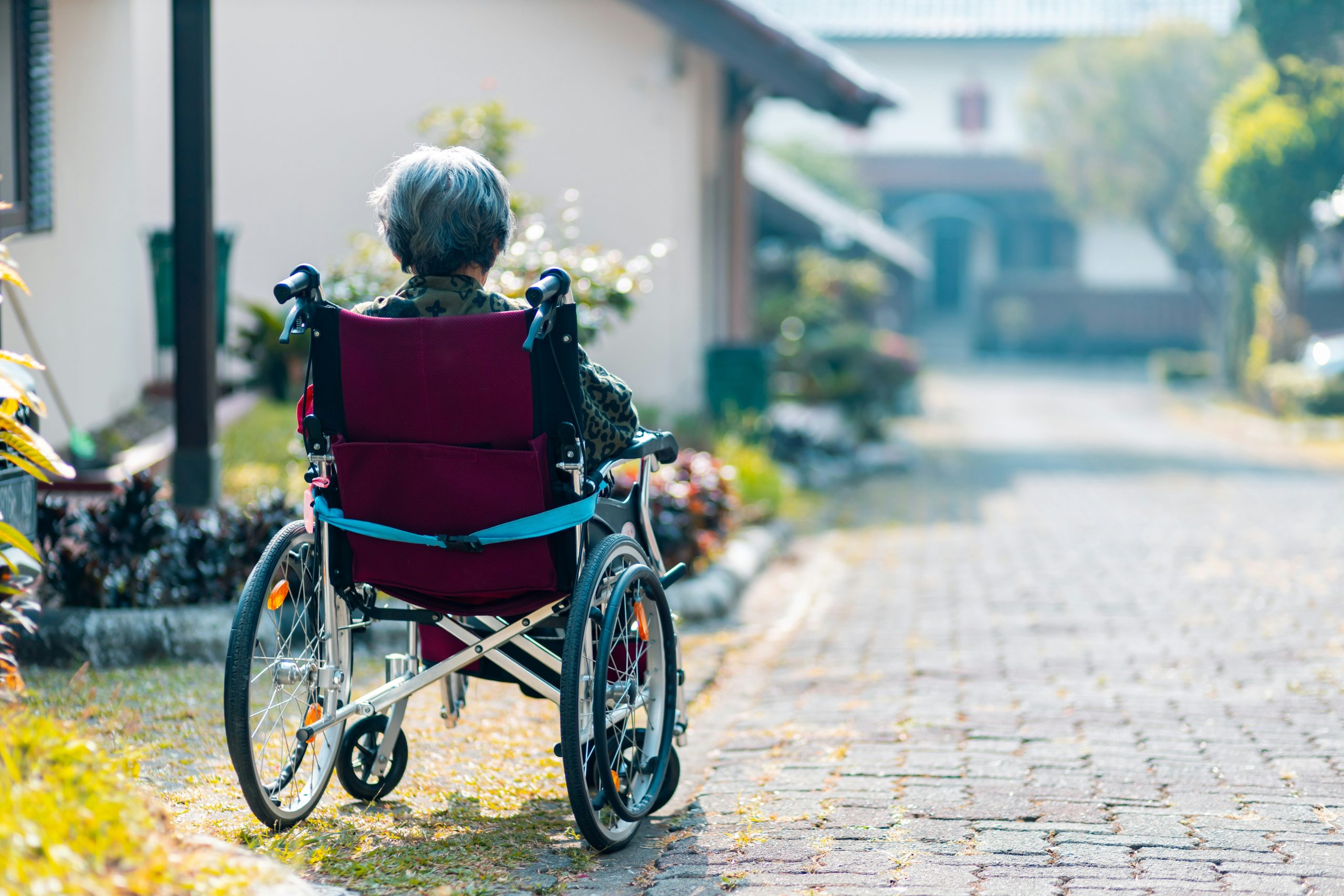
Should she use a wheelchair for outings?
Occasionally, for a long day out, it can mean going at all. As a default it reduces walking, which is the thing that rebuilds strength. Worth discussing with a physiotherapist.
What if she refuses to try?
Start smaller than feels worthwhile, and attach it to something she wants rather than to falls. Going to see someone beats going for a walk.
Can therapy really help with this?
NICE recommends considering cognitive behavioural interventions where exercise alone has not helped concerns about falling. Ask the GP what is available locally.
About Visiting Angels Cheshire East
Visiting Angels Cheshire East provides care at home across Macclesfield, Wilmslow, Knutsford, Congleton, Alsager and the surrounding villages of East Cheshire, along with Buxton, Whaley Bridge and the Staffordshire Moorlands towns.
- Getting out, not just getting by. Walking with someone, going with them to a group the first few times, and building back up is a normal part of a visit.
- No visit is ever shorter than an hour, which is what makes a walk possible rather than only the tasks.
- You see the same faces. Our carer turnover is 12 per cent, against a sector figure of 23.7 per cent (Skills for Care, 2025). Confidence is built with someone familiar.
- You choose your caregiver, and meet them before care starts.
- Short term support while someone recovers, reducing as they improve.
Val had support at home after her hip replacement:
“Super service, very pleasant and caring staff that came to see me when I had my hip replacement done. Will miss our tea and chat now.”
Valerie Hewitt, Google review
Not sure what you need yet? Start with a free assessment
Our free home care assessment is a visit at a time that suits you, with no obligation afterwards. In it we will:
- Work out what has been given up since the fall, which is usually more than anyone has said out loud.
- Talk through a realistic package, and what it would cost.
- Look at the money with you, and point you towards the funding, benefits and grants you may be entitled to.
- Point you at the GP and the free falls programme first, because for confidence those two do more than we can.
If someone has stopped going out since a fall, call us on 01625 720157. You can also send an enquiry, and you can see what our services cover.
Authored by Dr Haroon Ahmad, Managing Director, Visiting Angels Cheshire East.
Published 27 September 2026. Last updated 27 September 2026.
This article is general information, not medical advice, and no substitute for a GP, physiotherapist or other professional who knows the person. The plan described is illustrative and should be adapted on professional advice. Persistent low mood should be discussed with a GP. The author is a director of the company and is not acting in a clinical capacity, and Visiting Angels Cheshire East provides personal care at home rather than medical or nursing care. To the fullest extent permitted by law, GB Care at Home Ltd accepts no liability for any loss or injury arising from reliance on this article.